
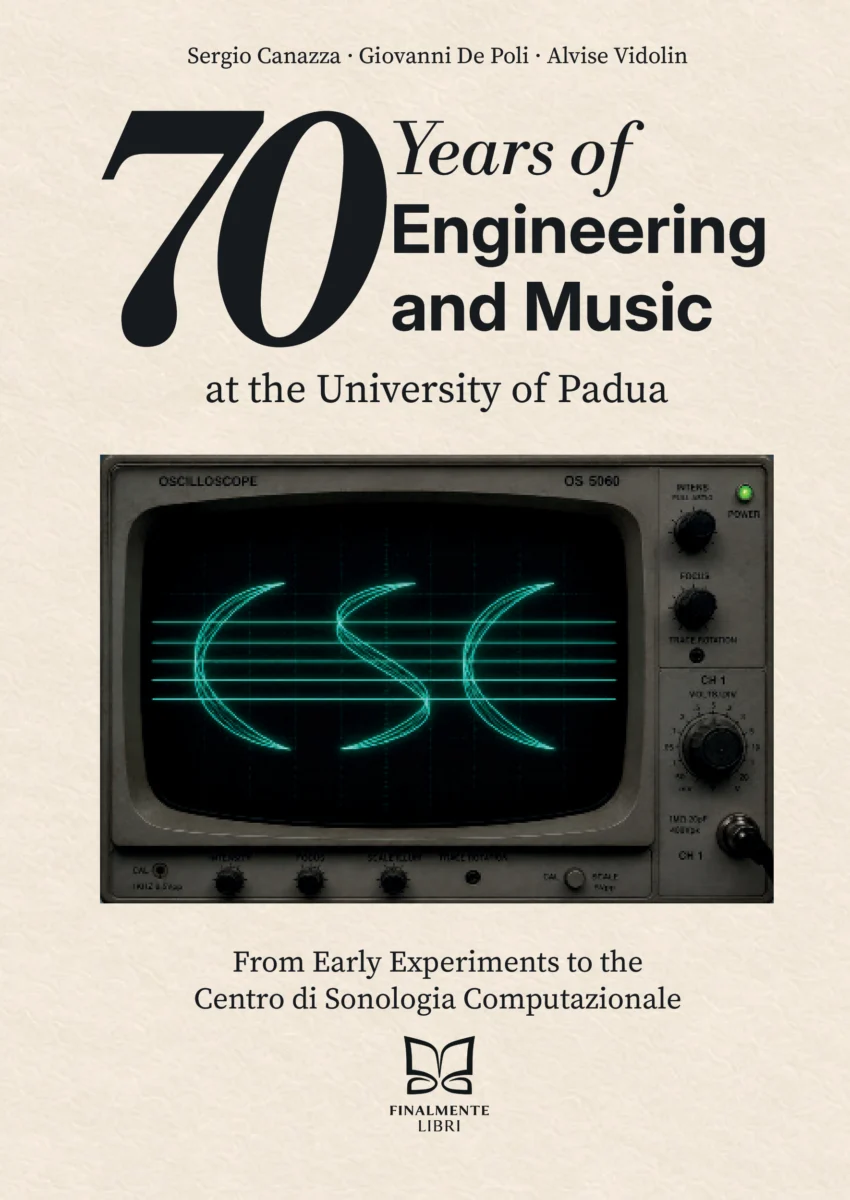

When the Computer Joins the Orchestra
70 Years of Engineering and Music at the University of Padua
An organ that produces sound using light, four computers in the orchestra pit, a pinball machine that plays a piano.
What you will find
Why you will love it
Language: English.
Foreword by Marc Leman.
Hardcover, 17 × 24 cm, with a die-cut cover and a title stamped in silver foil.
In Padua in 1957, Giovanni Battista Debiasi builds a photoelectric organ. Inside, a perforated wheel modulates the light from a bulb, and a photocell converts those variations into an audio signal. It is one of the early experiments featured in 70 Years of Engineering and Music at the University of Padua, the English-language volume in which Sergio Canazza, Giovanni De Poli, and Alvise Vidolin trace seventy years of collaboration among engineers, composers, and performers at the University of Padua.
That early research leads to the founding of the Centro di Sonologia Computazionale (CSC) in 1979. To show us what its laboratories create, the authors take us to the theater. In Salvatore Sciarrino’s Perseo e Andromeda, two musicians play a digital orchestra through four computers, while four singers perform onstage. In Carlo De Pirro’s installation Il caos delle sfere, anyone playing a game of pinball becomes the musician. The ball’s movements control a real piano.
The book also follows this research beyond the stage. How can an electronic work be performed again when the machines it was composed for are no longer operational? What ideas can artificial intelligence offer a composer? From restoring audio archives to technologies for more inclusive music education, the volume tells the story of computer music through the choices made by those who build the instruments and those who play them.
The atmosphere of the book
- the buzz of the lab
- scientific curiosity
- musical inventiveness
- camaraderie between musicians and engineers
- focused listening
- quiet reflection in the archives
«Art explores musical expression, while science seeks to understand the principles that underlie it.»